A remote power panel is a distribution panel placed out on the data hall floor, feeding racks through individual circuits. Busway is an overhead conductor rail that power taps off anywhere along its length. Both move distribution closer to the load and away from the room-level panel, which is the point of each. They differ in how capacity is allocated: an RPP fixes it at the panel, while busway leaves it distributed along the run. Many facilities use both.
What each one is
Remote power panel
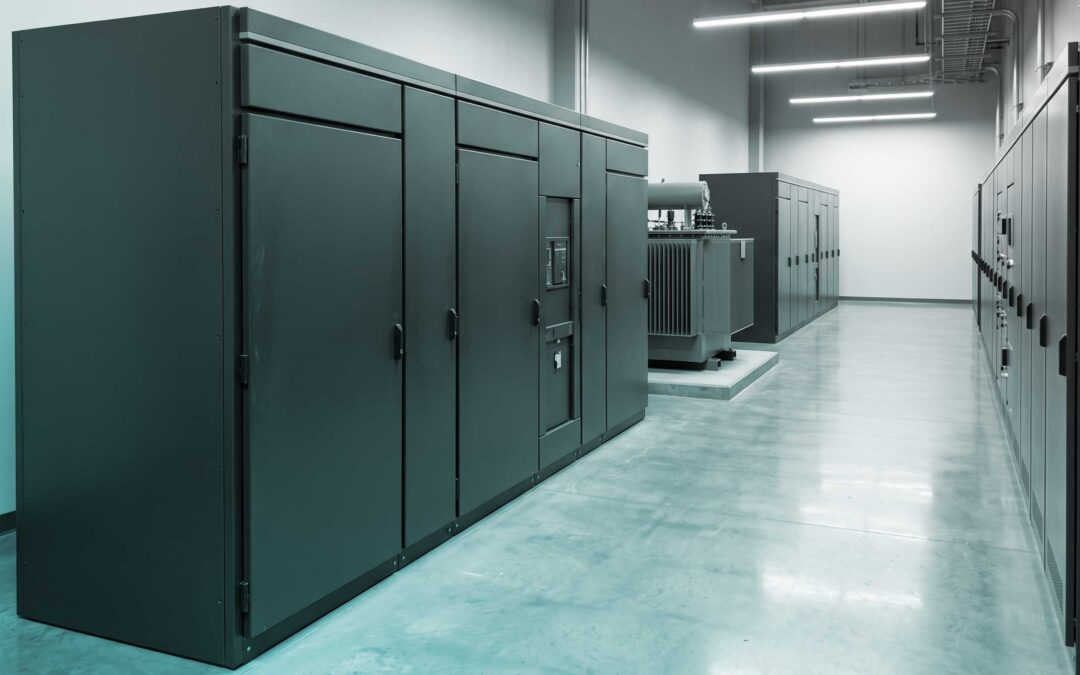
An RPP is a distribution panel positioned on the data hall floor rather than in an electrical room. It is fed from upstream distribution and contains branch breakers that feed individual racks through conduit or whips.
It is, functionally, a panelboard that has been moved closer to the equipment it serves. That shortens the branch circuit runs and frees electrical room space, but the distribution model downstream of it is conventional: one circuit per rack, fixed at installation.
Many RPPs include branch circuit monitoring, which gives per-circuit visibility that a traditional panel in an electrical room typically does not.
Busway
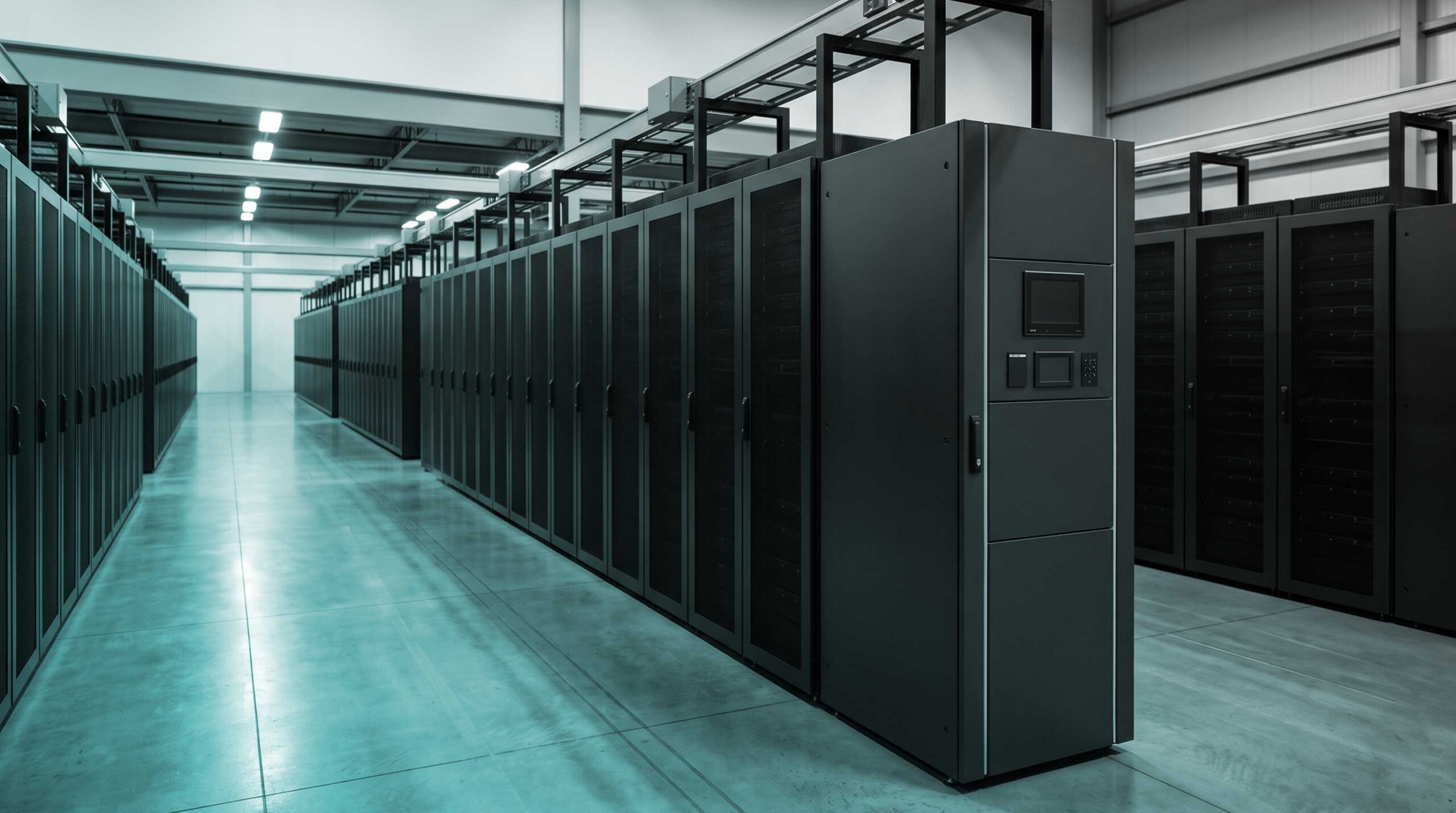
Busway is an enclosed conductor assembly, usually mounted overhead above the rack rows. Power is drawn off through tap-off boxes that attach at points along the run, each containing its own circuit protection and frequently metering.
Capacity is not allocated at a panel. It sits in the run, and connection points are added where and when they are needed. On track-style designs, tap-off boxes can often be repositioned without de-energizing the run.
The useful mental model: an RPP concentrates capacity at a point and distributes it outward through fixed circuits. Busway spreads capacity along a line and lets you draw from it wherever you need.
How they compare
| Factor | Remote power panel | Busway |
|---|---|---|
| Capacity model | Fixed at the panel, allocated per circuit | Distributed along the run |
| Adding a rack | New branch circuit from the panel | Add a tap-off box |
| What runs out first | Breaker positions | Tap-off positions or bus rating |
| Reconfiguration | Requires new cable pull | Often reposition a tap-off box |
| Floor space | Occupies floor area in the data hall | Overhead; no floor footprint |
| Cable volume | Individual runs to each rack | Concentrated in the run |
| Up-front cost | Generally lower | Generally higher |
| Metering | Commonly branch circuit monitoring at the panel | Commonly at each tap-off |
| Installation | Familiar to any electrical contractor | Needs contractor familiar with the product |
| Suits | Defined zones, stable layouts, raised floor | Changing layouts, phased build-out, overhead routing |
The table makes them look like alternatives. In practice they solve slightly different problems, and the sharper distinction is about where you want the constraint to live.
With an RPP, the constraint is the panel. You have a known number of breaker positions serving a known zone, and when those are consumed the zone is full regardless of what capacity remains upstream. With busway, the constraint is the run: amperage and physical tap-off positions along a line.
Why facilities often use both
Treating this as an either-or decision is the most common mistake on the topic. The two are frequently complementary rather than competing, and a facility can sensibly run both in the same data hall.
- Different zones, different needs. A stable colocation suite with a fixed cage layout suits an RPP. A high-density zone being built out in phases suits busway. There is no reason a single building must pick one model for every room.
- RPPs feeding busway. An RPP can serve as the distribution point that feeds one or more busway runs, combining panel-level protection and monitoring with busway’s flexibility downstream.
- Legacy and new build together. Retrofits frequently keep existing RPP-fed zones while adding busway to new or refurbished areas, rather than rebuilding distribution that is working.
- Different equipment profiles. Some loads genuinely want a dedicated circuit from a panel. Others benefit from being able to move without an electrician. Mixed estates often need both.
How to decide for a given zone
Five questions usually settle it.
- How stable is the layout? Fixed cages and defined tenant zones favor an RPP. Frequently reconfigured space favors busway.
- Is there a viable overhead route, with clearance and structural support, coordinated with containment, lighting and cooling?
- Is data hall floor space constrained? An RPP consumes floor area that busway does not.
- Is the zone built out all at once or in phases? Phased build-out favors a distribution path installed once and populated progressively.
- Where do you want monitoring? Branch circuit monitoring at an RPP and per-tap metering on busway give similar visibility by different routes.
Underneath those sits the same question that governs most distribution decisions: how many times will something in this room change, and how disruptive is each change? That question is covered in more depth in busway versus whips and conduit, and the logic carries across.
Sizing and planning points for each
Both architectures have a characteristic failure mode, and both are avoidable at design stage.
Remote power panels
The usual problem is running out of breaker positions while the feeder still has headroom. Circuit counts rise faster than total load, particularly where racks are dual-fed, so a panel can fill physically long before it fills electrically.
Plan position count alongside amperage, and check it against expected rack count at the circuit configuration you actually intend to use rather than the minimum.
Busway
The usual problem is sizing the run to today’s per-rack load. Density has climbed steadily, and a run sized exactly to current requirements can be full within a refresh cycle. Adding a second run to a live room is considerably more expensive than sizing for growth at the outset.
Tap-off positions are also a separate constraint from bus rating. A run can have amperage remaining and no physical space left for another box, so check position count at your expected box size.
In both cases the underlying error is the same: tracking amps while the thing that actually runs out is positions. That pattern and several related ones are covered in common power distribution mistakes.
Next step
Trilogy supplies both remote power panels and busway and tap-off boxes, along with rack-level distribution downstream of either. If you have a data hall layout and want both approaches costed against it, send it over.
Frequently asked questions
What is a remote power panel?
A remote power panel is a distribution panel positioned out on the data hall floor rather than in an electrical room. It is fed from upstream distribution and contains branch breakers that feed individual racks through conduit or whips. Moving the panel closer to the equipment shortens branch circuit runs and frees electrical room space. Many RPPs include branch circuit monitoring, giving per-circuit visibility that a conventional panel often does not.
What is the difference between an RPP and busway?
They allocate capacity differently. An RPP concentrates capacity at a panel and distributes it outward through fixed circuits, one per rack, determined at installation. Busway spreads capacity along an overhead run and lets you draw from it through tap-off boxes placed where they are needed. The practical consequence is what runs out first: breaker positions in an RPP, tap-off positions or bus rating on busway.
Can a data center use both RPPs and busway?
Yes, and many do. The two are frequently complementary rather than competing. Different zones in the same building can reasonably use different models, with stable cage layouts on RPPs and phased or high-density zones on busway. An RPP can also serve as the distribution point feeding one or more busway runs, combining panel-level protection and monitoring with busway flexibility downstream.
Which is cheaper, an RPP or busway?
An RPP generally costs less to install. Whether it costs less over the life of the room depends on how often the layout changes, because every rack added or moved means a new cable pull from the panel, whereas busway absorbs changes by adding or repositioning a tap-off box. In a stable zone the RPP usually wins on total cost. In a frequently reconfigured one, it usually does not.